|
Join us
for Hands-On Environmental Education!
Come for
interactive learning through hikes, crafts, games, wagon rides, and
stories.
Lessons
are designed for KINDERGARTEN Classes and their teachers. SOL's are
addressed! KinderCritters programs run March through early June.
For more information or a KinderCritters brochure, please call Camp Bethel at (540) 992-2940
or email us at camp.bethel@juno.com.
The students will be
involved in a number of activities, both fun and educational. The
following are a few activities that have been done before during a
KinderCritters session:
Activity 1
Tree
Cookies (from Project Learning Tree)--
In this activity students
will trace environmental and historical changes using their own
individual cross section of a tree trunk, or "tree cookie."
Students will then be allowed to decorate their tree cookie and
convert it into a necklace that they can take home with them.
Key Concepts: 1)
Organisms change throughout their lifetime. Species of organisms
change over long periods of time, and 2) While every organism goes
through a lifecycle of growth, maturity, decline, and death, its role
in the ecosystem also changes.
Skills: Observing,
Identifying Relationships and Patterns, Interpreting Information.
Activity 2
Birds
and Worms (from Project Learning Tree)--
Camouflage is an
important survival strategy in the animal kingdom. In this activity,
students will discover the value of protective coloration as they
pretend to be birds in search of colored worms or bugs (made of
colored pip cleaners).
Key Concepts: 1)
Organisms are interdependent; they all depend on nonliving components
of the Earth, 2) Altering the environment affects all life
forms-including humans- and the interrelationships that link them, and
3) Organisms adapt to changes in the environment according to the
genetic and behavioral capacity of their species.
Skills:
Determining Causes and Effects, Analyzing, Identifying Relationships
and Patterns, Predicting.
Activity 3
Wagon
Ride around Camp
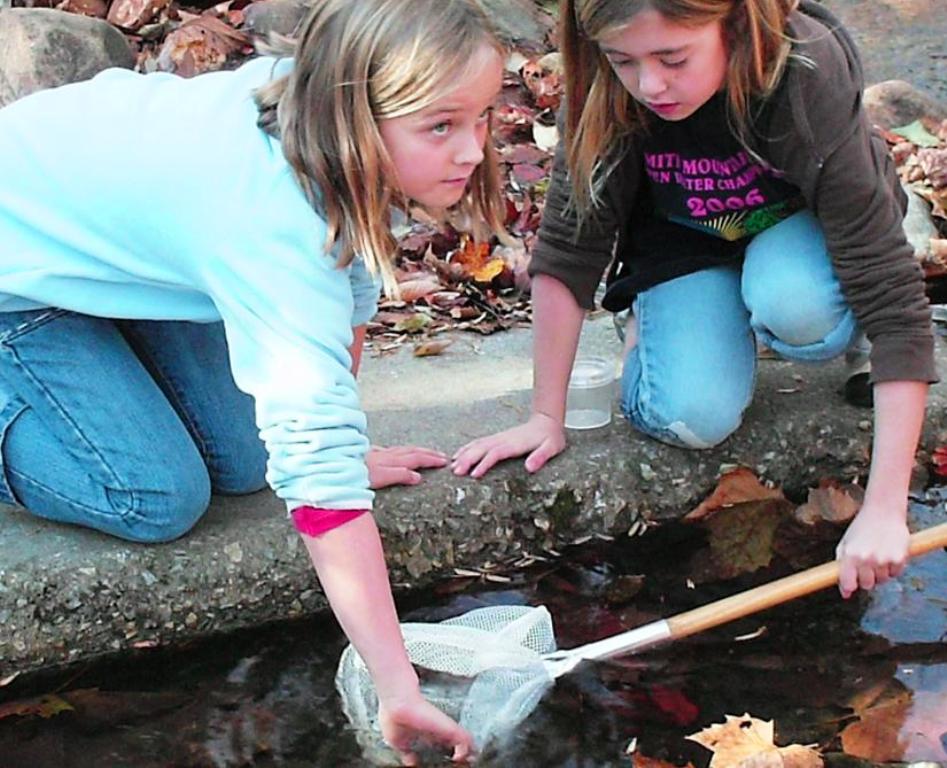
During this tour students
will get to see and observe the diversity of life here at Camp Bethel
by viewing different plants and animals in different physical
settings. Students will have pointed out to them different
habitats (such as pond, meadow, stream, woodland, etc.). With
luck the students are likely to see rainbow trout, squirrels, a
variety of birds, sunning water snakes, and maybe even a deer or wild
turkey.
Key Concepts: 1)
Organisms are interdependent, 2) Plant and animal diversity exists and
will vary depending upon the living and nonliving components of the
environment.
Skills: Observing,
Classifying and Categorizing, Comparing and Contrasting.
Activity 4
Hike to
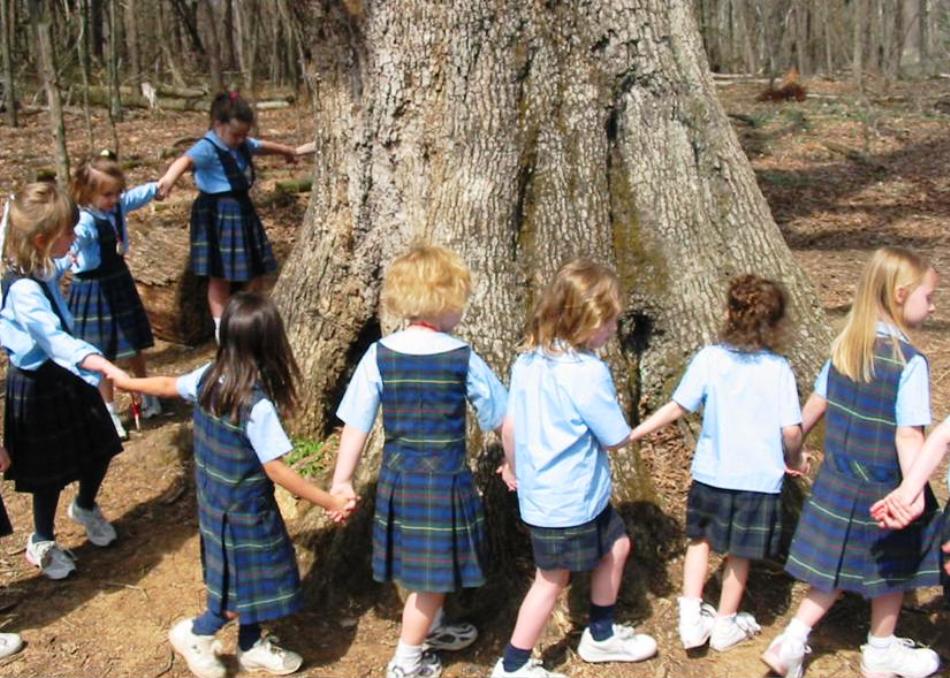
the Big Oak
Students will embark on a
hike that will conclude at the base of our 180+ year old Oak Tree that
measures 99 feet tall with a circumference of 28 feet (all
estimations). During the hike, students will come across a
variety of plants and wildlife and be asked at certain points to
compare things according to shape, size, colors, etc. This
activity requires the students to use their senses in feeling,
smelling, and observing little wonders pointed out by the leader.
Students may also be asked to carefully listen for sounds such as
birdcalls, squirrel chatter, leaves rustling in the wind, twigs
cracking under the feet of animals in the distance. Upon arrival
at the tree, students will have an opportunity to marvel at the size
and compare it to other tress in the vicinity as well as other large
non-living objects they are familiar with. Usually they will be given
the opportunity to use their hands and/or rope to measure the
circumference of the tree so that they can compare a numerical figure
to something more tangible.
Key Concepts: 1)
Biological diversity results from the interaction of living and
nonliving environmental components, 2) Organisms change throughout
their lifetimes in a cycle of growth, maturity, decline, and death
with each organism's lifecycle varying, and 3) As humans we depend on
all of our senses to gather impressions of our environment which our
brain then sorts out for future references.
Skills: Observing,
Comparing and Contrasting, Classifying and Categorizing, Reasoning,
Formulating Questions, Identifying Relationships and Patterns.
|